In August 2025, a report from MIT’s NANDA initiative went round every boardroom with one number: about 95% of enterprise generative AI pilots had no measurable effect on profit and loss. It was built on 150 leader interviews, a survey of 350 employees and an analysis of 300 public deployments (Fortune).
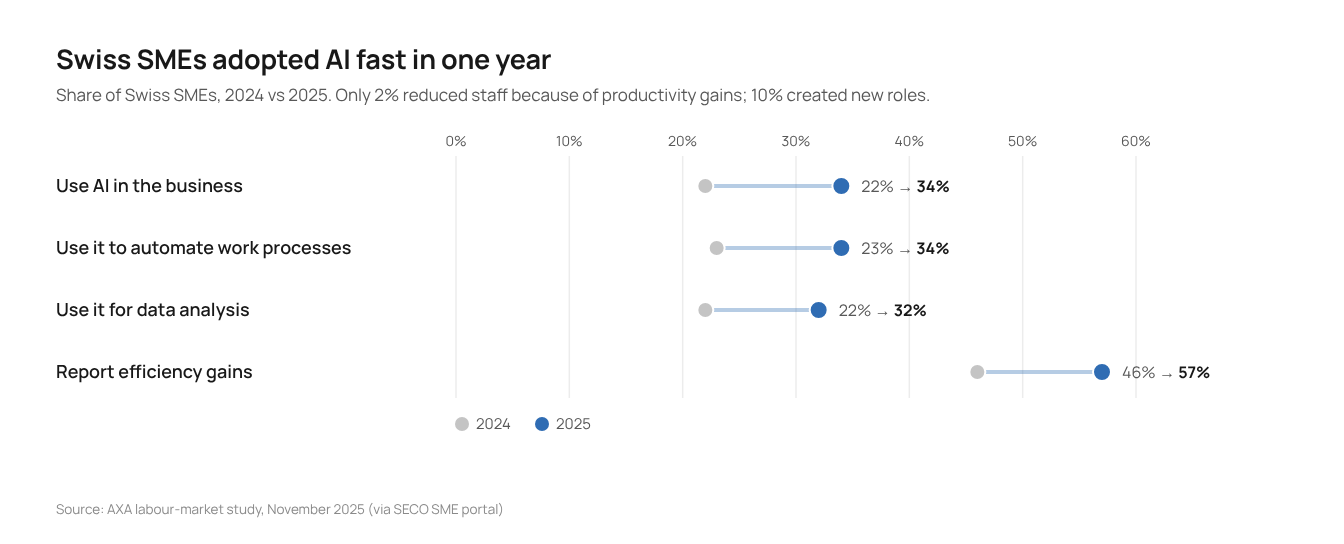
Swiss companies are not standing still. According to AXA’s annual labour-market study, the share of Swiss SMEs using AI rose from 22% to 34% in a single year, and 57% now report efficiency gains (SECO SME portal). But the most common uses are still translation and correspondence: tools on individual desks, not processes that have changed. And only a third of these firms have clear rules on what data staff may type into an AI tool.
So the question is no longer whether teams will use AI. It is why a small minority turn it into hours they can actually spend elsewhere, while most stay stuck in pilot mode. Looking at the research, and at what we see in Swiss operations, HR, finance, supply chain and customer service teams, the winners share five habits.
Lesson 1: Start where the repetitive work is, not where the budget goes
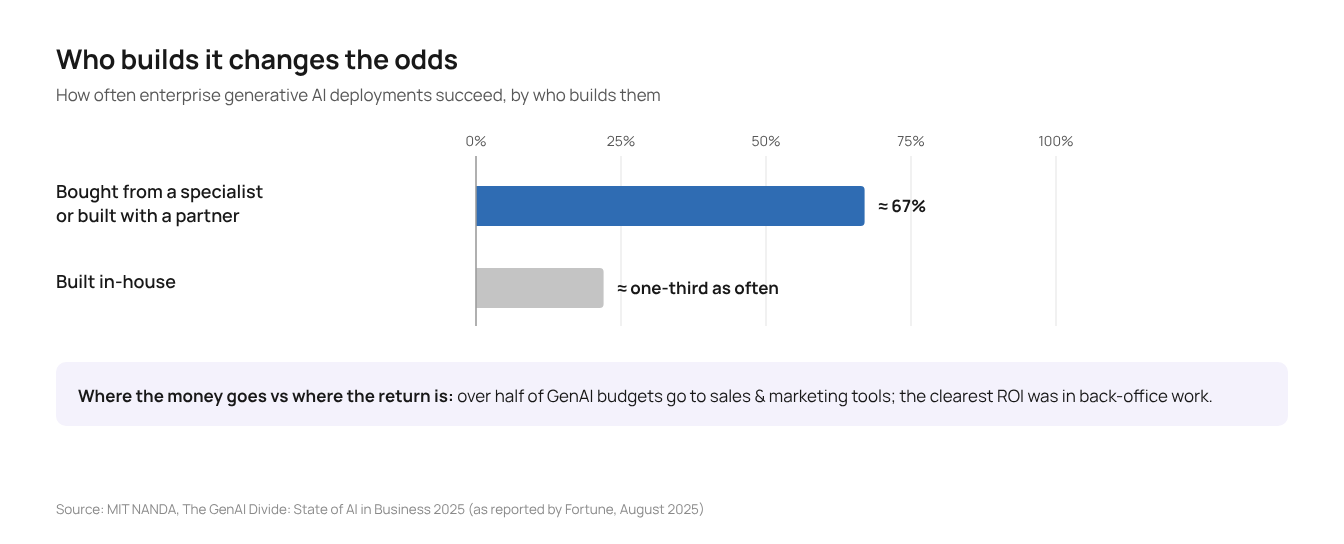
The MIT team found that more than half of generative AI budgets go to sales and marketing tools. The clearest returns, however, came from the back office: less outsourced process work, lower agency spend, simpler operations. The visible use cases attract the money; the quiet ones pay it back.
That quiet work is not small. Asana’s survey of more than 13,000 knowledge workers found they spent around 60% of their time on “work about work”: chasing status, searching for information, switching between tools (Asana Anatomy of Work Index). In practice, it looks like the Monday report a team lead rebuilds by hand, the same twenty HR questions every month, invoices matched line by line, or supplier emails copied from one system into another.
What it takes. List the five most repetitive tasks in one team and put an hour figure on each. Pick the one with clear inputs, a predictable output and an obvious owner. That is your first agent, not the flashiest idea in the brainstorm.
Lesson 2: Let the business line own it
One of the strongest patterns in the MIT data is about who drives adoption. Companies that succeeded gave line managers, not only a central AI lab, the authority to push tools into daily work. The person who knows where the hours go is the head of operations, HR or finance, not the CTO.
This does not sideline IT. Security, data access and architecture still need clear guardrails. But a first agent that drafts a weekly report or answers recurring HR questions does not need a large IT project. It needs a business owner who can say what “good” looks like, and a handful of real users willing to test it.
What it takes. A named business owner, a named process and a pilot with real users within two to three months. If the initiative needs a steering committee before anyone touches a real workflow, it is already too big.
Lesson 3: Keep people in the loop, on purpose
In February 2024, Klarna announced that its new AI assistant had handled two-thirds of its customer service chats in its first month, doing the equivalent work of 700 full-time agents (Finextra). Fifteen months later, its CEO told Bloomberg the push had gone too far: focusing on cost meant that “what you end up having is lower quality”. Klarna started recruiting human agents again, promising customers there will always be a person if they want one (Maginative).
The research explains why. In a study of 5,179 customer support agents, an AI assistant raised issues resolved per hour by 14% on average and by 34% for novice and less-skilled agents, with minimal effect on the most experienced (Brynjolfsson, Li & Raymond, NBER). The AI spread the know-how of the best people to everyone else. In a separate experiment with 758 BCG consultants, those using AI on tasks it handles well completed 12.2% more tasks, 25.1% faster, with more than 40% higher quality. On a task just outside its reach, they were 19 percentage points less likely to get the right answer than colleagues without AI (Dell’Acqua et al., Harvard Business School working paper).
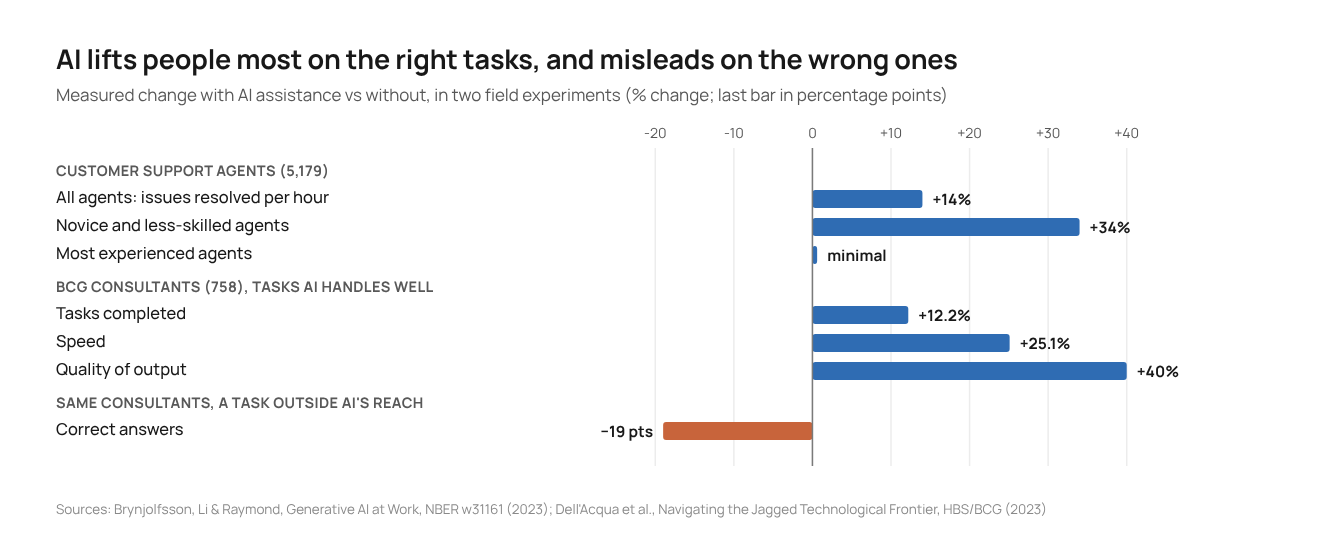
Both lessons point the same way. AI makes people better at the right tasks and confidently wrong at the wrong ones. Human judgement is not a courtesy; it is the control that keeps quality up.
What it takes. Design every agent with a human checkpoint. Decide upfront which decisions stay with people (approvals, exceptions, anything a customer or employee will feel) and let AI prepare, draft, match and summarise around them.
Lesson 4: Count hours, not prompts
“We use AI” is not a result. Hours returned to a team are. The simplest business case multiplies three things you already know: how long a task takes, how often it happens and how many people do it. Measure that baseline before anything is built, or you will never be able to prove the gain afterwards.
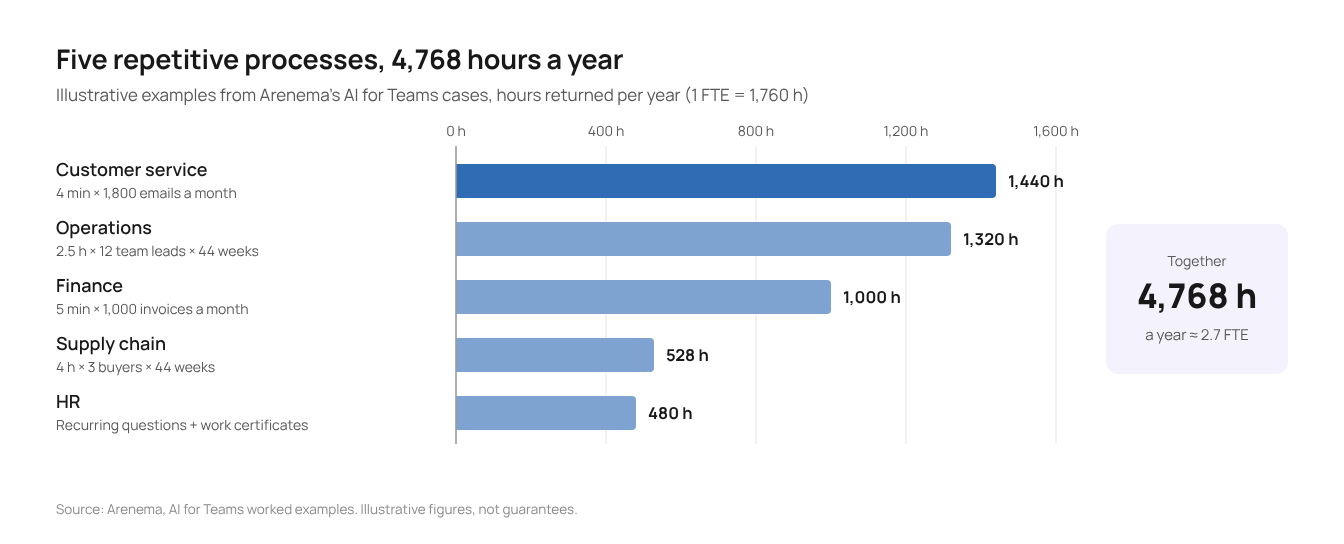
Here is what that arithmetic looks like on five typical processes from our AI for Teams worked examples. None of them is spectacular on its own. Together they come to 4,768 hours a year, or about 2.7 full-time equivalents.
| Team | What AI takes on | What people keep | Hours a year (illustrative) |
|---|---|---|---|
| Operations | Weekly KPI reports, shift summaries, incident logs | Priorities, trade-offs, talking to the team | 1,320 |
| HR | Recurring policy questions, first drafts of work certificates | Sensitive cases, final wording, decisions | 480 |
| Supply chain | Quote comparison, order follow-ups, supplier emails | Negotiation, supplier relationships | 528 |
| Finance | Invoice capture and matching, flagging exceptions | Approvals, controls, closing | 1,000 |
| Customer service | Sorting emails, drafting replies, routing requests | Complex cases, complaints, anything a customer will feel | 1,440 |
Those hours are not a headcount target. In the AXA study, only 2% of Swiss SMEs reduced staff because of AI productivity gains, while 10% created new roles. The time goes back into the backlog nobody gets to, into customers, and into quality.
What it takes. One spreadsheet line per process: minutes per task, volume, people involved, hourly cost. Agree on it with the business owner before the pilot, and measure it again three months after go-live.
Lesson 5: Bring in a partner, and plan for them to leave
The MIT study found that AI tools bought from specialists or built with a partner succeeded about two-thirds of the time. Internal builds succeeded only about a third as often. The successful young companies, the lead author noted, pick one pain point, execute well and partner smartly.
A partner brings method, patterns that already work and the discipline to ship. The risk is the opposite one: a dependency that never ends. The right engagement has a planned end point, with your own people trained to run, adjust and extend what was built. Governance belongs in the same plan: Swiss data protection (nFADP), the EU AI Act where it applies, hosting in Switzerland or the EU, and clear rules for staff on what data goes where.
What it takes. A partner who works with the business line, ships a first pilot in weeks rather than quarters, and writes the handover into the plan from day one.
Where to begin?
- Pick one team and one process. The one everybody complains about on Mondays is usually the right one.
- Measure the hours before you touch anything. Minutes per task, volume, people. That baseline is your business case.
- Decide what stays human. Write down the approvals, exceptions and conversations that people keep, then let AI prepare everything around them.
- Set the end date for outside help. Agree from the start when your team takes over, and what it needs to learn to do so.
So: where do your teams lose the most hours each week — the reports rebuilt by hand, the questions answered for the tenth time, or the data copied from one system to another? That is where AI for Teams starts. Arenema helps operations, HR, supply chain, finance and customer service leaders put AI on repetitive work, with a first pilot in two to three months, support through implementation and a planned handover to your own people. Human-centred, compliant with Swiss data protection, and with no large IT project.
Discover AI for Teams and book a 30-minute call: arenema.com/ai-for-teams