
A Swiss company of 50 to 500 people can buy engineers, consultants or an offshore contract. None of them buys what is usually missing: one person accountable for technology inside the leadership team.
The pattern repeats across the Swiss mid-market. The commercial plan depends on software. The software depends on two or three people. And the executive who has to defend the budget cannot verify a single estimate behind it.
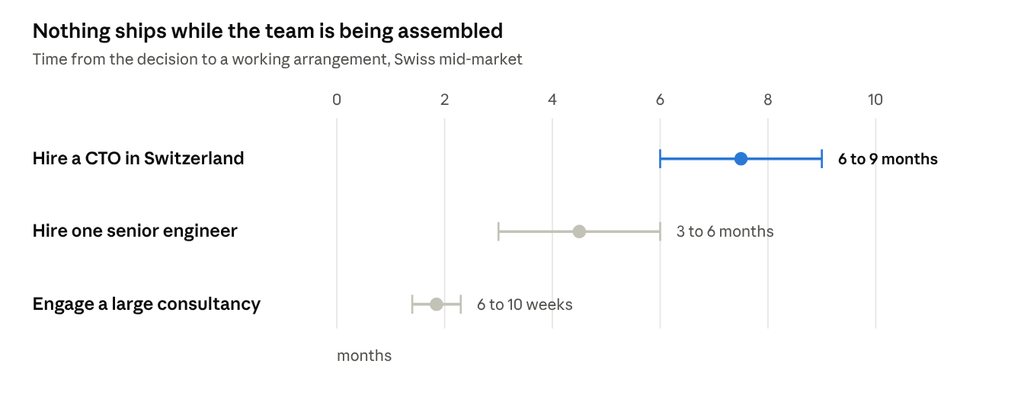
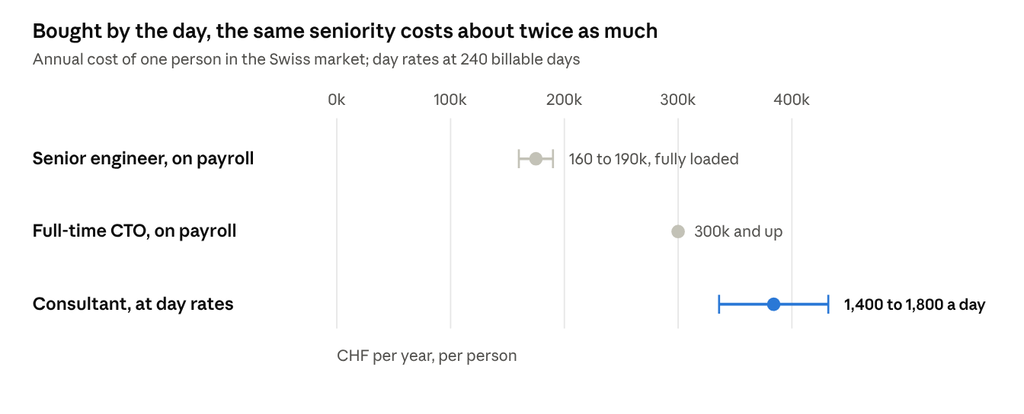
Every available route has a known defect. Recruiting in Switzerland takes six to nine months for a CTO and three to six for each senior engineer, at 160,000 to 190,000 CHF fully loaded. A large consultancy arrives in six to ten weeks at 1,400 to 1,800 CHF a day, with an account manager between the client and the work. Contracting offshore directly works on the rate card until specification, timezone and quality control land on someone who already has a full-time job.
The six problems below are the ones Swiss CEOs describe when the subject comes up, in the order they usually become urgent. Each one ends with what it actually takes to remove it.
Problem 1: Nobody at leadership level owns technology
The head of IT runs operations, not strategy. The first developer is the de facto architect and is overloaded. Decisions that shape the next three years get taken by whoever argues hardest in the room.
This is rarely the result of neglect. Swiss mid-market firms grow past the point where the founder can hold the technical picture long before they reach the size that justifies a full-time CTO at 300,000 CHF and up. The gap is structural, and it lasts for years.
What it takes to remove it. A technology owner in the leadership team from week one, with the authority to decide architecture and the obligation to answer for delivery in front of the board. Fractional works here precisely because the role is judgement, not hours: two to three days a week buys the decisions, not the attendance.
Problem 2: No straight answer on when it will be done
Dates that move a fortnight at a time are not a scheduling problem. They are a measurement problem.
Most mid-market delivery functions report on effort and intention. Almost none report throughput, cycle time or defect escape rate taken from their own tooling. Without those, an estimate cannot be challenged by anyone outside engineering, so the CEO either accepts it or overrules it on instinct. Both are bad options, and both get used.
What it takes to remove it. A baseline measured from the client’s own systems in the first fifteen days, then a ninety-day plan that is costed and has named owners. Once throughput and defect rates are published monthly, a date becomes an argument with evidence rather than a negotiation about optimism.
Problem 3: Two people know how everything works
Every CEO in this position can name them. So can an acquirer’s technical due diligence, an insurer’s questionnaire and a large customer’s vendor assessment.
Key-person concentration is the one technology risk that is visible to outsiders before it is visible internally. It does not announce itself through outages. It announces itself through a discount in a valuation, a delayed security approval, or a resignation that becomes a company-level event.
What it takes to remove it. Documentation and architecture decision records produced as the work happens, not as a closing exercise, plus a capability matrix that states who on the client side can now do what. The test is simple and uncomfortable: could the company run this without the people who built it?
Problem 4: The hiring market has already beaten you
The search is in month seven. Two senior vacancies have been open since spring. Every candidate who fits is employed, in Zurich or Zug, and expensive.
The cost of this is measured in quarters, not francs. The commercial window moves while the team is being assembled, and the plan that justified the hiring is no longer the plan. In Switzerland the decision is also close to irreversible: headcount carries notice periods, redundancy process and a social cost that a CEO will delay rather than repeat.
What it takes to remove it. Capacity that already exists as a team, not as a set of open requisitions. A squad that has shipped together ramps in about thirty days rather than a quarter, because the first sprint is productive instead of exploratory — and because it can be reduced at thirty days’ notice when the plan changes.
Problem 5: The CFO asks what the technology budget buys
A seven-figure line item is defended with velocity charts that nobody outside the delivery team believes. The budget round then settles the question politically rather than commercially.
The missing number is cost per feature shipped. Most technology leaders have never had it, which means technology is the only major line in the business that is argued without unit economics. Marketing has cost per lead. Operations has cost per order. Engineering has a headcount plan.
What it takes to remove it. Establish the real cost per feature in the first fifteen days and publish it monthly against that baseline. On comparable engagements, making the number visible is what then makes reductions arguable: 40% of development cost, 30% of cloud spend and 50% of APM tooling cost removed on a single programme.
Problem 6: A client or a regulator is asking questions you cannot answer yet
An enterprise customer’s security questionnaire is holding a signed-in-principle contract inside procurement. Someone has asked for ISO 27001 and named a date. NIS2, DORA, the EU Cyber Resilience Act or IEC 62443 now reach the business through its customers even where they do not apply directly.
Compliance in a mid-market firm is usually run in the evenings by people with day jobs. It competes with the roadmap for the same engineers, and it loses until it becomes an emergency.
What it takes to remove it. Readiness work with its own fixed scope, its own price and its own team, running alongside delivery rather than inside it. For one manufacturing group that meant 85 policies, standards and templates, a full audit of the R&D function with a severity-rated roadmap, and a certification plan — in three months.
Why these six have to be solved together ?
Read individually, each problem has an obvious remedy. Read together, they explain why the obvious remedies keep failing.
A delivery team bought without leadership becomes a cost line nobody can defend at the next budget. Leadership bought without a team becomes a plan nobody can execute. Measurement bought as a consulting exercise becomes a report that changes nothing, because the person who wrote it does not have to live with the numbers.
This is the reasoning behind the model Arenema calls CTO + Squad. An Arenema partner joins the client’s leadership team as CTO from week one, two to three days a week, reporting to the CEO or the board. From day thirty a blended squad — an EU tech lead in the client’s timezone plus three to eight engineers in India — delivers against the plan that partner wrote. Both sit under one Swiss contract, with one Swiss entity accountable.
The structural point. The person who writes the plan is the person answerable for shipping it, and he is a partner in the firm rather than a placement. That single arrangement is what makes measurement credible, accountability personal and the exit negotiable.
What it costs, and why the commercial model matters more than the rate
The comparison below takes one configuration — a squad of five including the tech lead, a CTO present two and a half days a week, on a twelve-month commitment — and prices it three ways. Swiss employment costs are fully loaded; consultancy rates are the low end of the Swiss market.
| Route | Monthly, all in | Time to a working team | Who is accountable |
|---|---|---|---|
| Arenema CTO + Squad | 48,828 CHF | 30 days | A named partner in the leadership team |
| The same team, hired in Switzerland | 94,583 CHF | 6–12 months | The CEO, from day one |
| The same team, via a large consultancy | 167,200 CHF | 6–10 weeks | An account manager |
Over twelve months that is 586,000 CHF against 1.13 million in-house and 2.01 million through a consultancy. The saving is real, but it is the least interesting number in the table.
What actually changes the outcome is the unit being bought. A day rate per head rewards a supplier for adding people and extending time, which is the opposite of the client’s interest. A fixed monthly fee for a defined capacity and a set of outcomes means that solving a problem by adding an engineer is the supplier’s cost, not the client’s. Entry points run from 9,000 to 13,000 CHF a month for leadership alone, to 37,000–72,000 for leadership plus a squad, with fixed-scope workstreams priced separately so the run cost stays stable.
Where to begin ?
No CEO should commit to a model like this on the strength of an argument. The engagement is deliberately structured so that the early steps are reversible: the fifteen-day assessment is free for early adopters and its output is the client’s to keep either way, anyone who underperforms is replaced within fifteen days at the supplier’s cost, the initial term breaks at six months, and transition, repositories and documentation sit in the contract as an exit schedule executable on sixty days.
- Find out what a feature actually costs you. Before any supplier decision, establish throughput, defect rate and cost per feature from your own systems. The number usually surprises the board more than the engineering team.
- Name the owner. Decide whether technology has a seat in the leadership team or an escalation path into it. If the honest answer is neither, that is the first problem to fix, with or without outside help.
- Separate the run from the deadline. Keep roadmap delivery and fixed-scope obligations — certification, migration, platform work — on separate budgets and separate teams, so one cannot quietly consume the other.
- Test the exit before you sign. Ask any supplier what the client keeps if the relationship ends in month seven. The answer tells you what kind of arrangement you are actually entering.
So: which of the six is currently costing you the most — the dates you cannot verify, the people you cannot replace, or the budget you cannot defend? If one of them is the reason this article got read to the end, that is the conversation worth having. Arenema offers a 60-minute discussion and, for the first clients on this model, a 15-day delivery assessment at no cost: the baseline, the costed 90-day plan and the risk register, kept whether or not anything follows.
Contact us ! https://www.arenema.com/contact